
Give volunteers fulfillment, not friction
We lament that people volunteer less now. Our lamentations may be misdirected. What looks like a volunteer recruitment problem may actually be a volunteer experience problem.
The psychology is pretty straightforward. People tend to find fulfillment when they have some control over what they’re doing, when they feel competent and useful, and when they feel connected to something larger than themselves. Simple enough. Also remarkably easy to screw up.
At this point in my career, I’ve limited my work to advising, speaking, counseling, and writing with my husband, Dr. Otis Fulton, a social psychologist. That has left me more time to repay some debts of service to organizations that have helped me and my family. Chief among them is a local chapter of The Arc, which serves people with intellectual and developmental disabilities.
My oldest child, Anna, is 35 and has Down syndrome, autism, type 1 diabetes, and Princess Syndrome. You can guess what the last one is.
So I started volunteering and thought, “What this place needs is a volunteer infrastructure. That’ll be easy. I’ve been doing this for 37 years. It’s as natural as breathing.”
I was wrong.
A Laboratory for Human Fulfillment
What I found was a laboratory for human fulfillment—and the lack of it. Some volunteers were so deeply invested in their work that they had built moats around their areas of influence. In one case, a volunteer had posted threatening signs around his work area. No one was allowed to touch his screwdrivers. The screwdrivers had been donated to the organization; they weren’t even his.
At the other end of the spectrum were volunteers with valuable professional skills they wanted to contribute but couldn’t, because nobody had ever asked what they wanted to do or what they were good at. They had simply been assigned whatever task needed doing.
And then there were the people who disappeared. When I asked why they stopped volunteering, some said, “No one called me again.” Others said, “I didn’t know what to do when I was in the building.”
That’s not a recruitment problem. That’s an experience problem.
Your Fulfillment Is Not My Fulfillment
All of this gets at something nonprofit staff can easily miss: your idea of fulfillment and fun is not necessarily theirs. Their idea of fulfillment is the one that matters.
One volunteer’s idea of a wonderful afternoon may be working shoulder to shoulder with a person with an intellectual disability. Another person may find that uncomfortable or exhausting. Find out.
Another volunteer may be perfectly happy alone in a gigantic warehouse, sorting, cleaning, or pricing stuff with earbuds in, listening to The Telepathy Tapes. These are the people who were happiest playing Tetris alone in the ’80s. They are fine. Let them be fine. Keep inviting them into other things, but understand that they may never walk through that other door.
Someone else may light up at the opportunity to build your digital infrastructure from scratch. Let them. Stay involved, provide guardrails, and pay attention—but let them own something.
The point isn’t to give volunteers the experience you think they should want. It’s to understand the experience they want and make it possible.
And Then There’s Friction
Friction is all the stupid little stuff that makes volunteering harder than it needs to be:
I don’t know when or where to show up.
I don’t know the rules.
There’s no water.
It’s freezing, or it’s 94 degrees.
People are yelling at me and I don’t know why.
I worked really hard on something and nobody noticed.
Somebody noticed my work only to tell me I did it wrong.
Friction is not knowing who’s in charge or whom to ask for help. It’s having no instructions. It’s wondering whether anybody notices how often you volunteer, or whether anybody would notice if you stopped. It’s arriving ready to help and discovering that you have no connection to the other volunteers and no obvious place in the group.
Each bit of friction answers a question the volunteer may never say aloud: Do these people actually want me here? Volunteers want clarity. Only you can give it to them.
When “The Organization” Becomes “Ours”
When volunteers are satisfied and fulfilled, something interesting starts to happen. They aren’t simply unpaid staff. They’re donors, giving something extraordinarily valuable: their time.
And if you do this well, the line between the organization and me starts to blur. The building becomes our building. The mission becomes our mission. What happens there becomes something we are responsible for.
That psychological ownership is incredibly valuable. It can also be incredibly difficult, because people who genuinely feel ownership have opinions. Lots of them.
Longtime volunteers may want things to stay the same, while newer volunteers may want clearer systems. Some people want a hand on the rudder; others are perfectly happy pulling an oar. Both are useful, and they need different things from you.
This is where staff instincts—and volunteer middle management—can get us into trouble. Overcommunicating feels unnecessary; it usually isn’t. Transparency can feel dangerous; it usually isn’t. Staff leadership should be clear, but leadership does not have to mean control.
During the heyday of the American Cancer Society’s Relay For Life, where I was a vendor partner, we used a mantra that kept everybody square: Volunteer led; staff driven. I’ve never found a better one.
The volunteer owns it. Staff make it possible.
Volunteers Need Autonomy—and Structure
Every person wants some degree of control. Volunteers want it. Staff want it. Organizations hire employees rather than use volunteers for many reasons, but one is straightforward: employment gives the organization considerably more authority over when someone shows up, what they do, and how the work gets done.
Volunteers can walk away anytime they want, and that changes the management equation. With volunteers, authority is limited. Influence matters enormously.
You support them. You guide them. You empower the ones who want to be empowered and provide clarity to the ones who want direction. You console them when something goes sideways. You recognize them and celebrate them. And occasionally, you have to just nice the crap out of a situation to get anything done. (In your mind, read the line from The Martian: “I’m gonna science the s!%+ out of this.”)
People who are truly excellent at working with volunteers are masters of human interaction. They understand that authority is limited and relationship is everything. You build enough trust, clarity, competence, and shared purpose that people choose to move with you.
Most people don’t want to be managed. They want to be enabled.
Focus on the Experience
That distinction matters when I look at the organization where I’m volunteering. We haven’t struggled to find people who want to help. The desire is there. What we’ve struggled with is helping those people gain a foothold after they raise their hands.
Our intake systems weren’t good enough. Our training systems weren’t good enough. We could get volunteers interested, but we weren’t nearly as good at getting them comfortable, connected, useful—and sticky. When they leaned in, staff or another volunteer sometimes told them they were doing things wrong in, let me be delicate here, less-than-graceful ways.
That experience has made me wonder whether some of what we describe as a decline in volunteerism may also involve something less comfortable: maybe we aren’t always providing a very good experience once people volunteer.
Yes, social norms have changed. People are busy. Many are under financial pressure. There are a hundred competing demands for their attention. Those things matter. But our own systems matter, too.
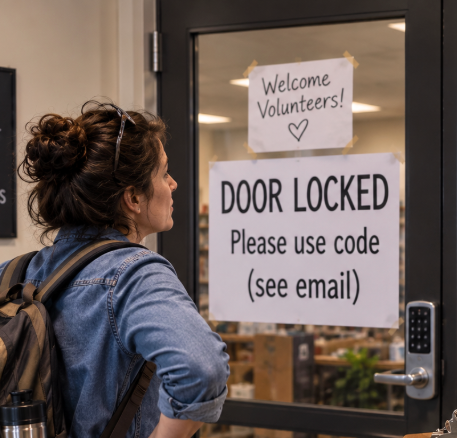
When I first began volunteering at my local Arc as board president, one of the first things I did was install a lock with a code system. We had been preventing people from accessing the building to volunteer when they wanted to, for absolutely no good reason.
That little change communicated something: I trust you. You know what to do. I want to make it easier for you to help.
I wish I could say I did 14 other smart things. I did not. That was my zenith.
But the lesson stuck. We ask people to give us something precious—their time—and then sometimes make it unnecessarily difficult for them to give it. We create friction where there should be fulfillment. We give ambiguity where people need clarity. We give control where they want direction and direction where they desperately want some control.
Then we wonder why they disappear.
So before you launch another volunteer recruitment campaign, ask a different question: What happens after somebody says yes? Do they know where to go and what to do? Does somebody know their name? Can they contribute in a way that feels meaningful to them? Does anybody notice when they show up—and does anybody notice when they don’t? Does someone call and check on them?
Recruitment gets someone through the door. A good experience makes them want to come back.
Removing friction may be the most important volunteer recruitment strategy you have.