
It's OK to Give Up Changing Uncle Bob’s MAGA Mind
If we really love Uncle Bob, maybe we don’t even want Uncle Bob to change his MAGA mind.
Every day, Otis and I read news about the latest Trump controversy. It might involve inappropriate language, evidence of grift, meandering leadership, military malfeasance—whatever. Every time, we marvel that his base of support, roughly 35% of Americans, doesn’t abandon him.
Katrina’s family is solidly Southern Baptist. Personal decorum, truth-telling, and following the Ten Commandments used to be the bar for a politician, and indeed for any person who might play a significant role in one’s life.
No more. All those requirements have been set aside to accommodate Trump. Rationalizations are made. Facts are ignored. News is avoided. Together, those forces make any meaningful movement in opinion highly unlikely.
Why? Because support for Trump is anchored in identity, community, and commitment to a shared worldview. These are resistant to change. Sort of like concrete is resistant to the flow of water.
Here’s why we all should give up trying to change our own Uncle Bob.
Politics as Identity, Not Preference
When levels of polarization become extreme, political affiliation stops functioning like an attitude and starts functioning like a social identity—more like a religion or tribe.
One beloved relative of ours recently said, when asked if they are still supporting Trump, "Except for what he does and says, I do." This is a reflection of identity, not decision-making.
Supporting Trump and MAGA becomes part of who someone is, not just what they think. It follows that attacks on Trump are processed as attacks on the self. No one is eager to attack their own identity or friendly to having it attacked. Protecting that identity becomes one more reason to hold onto MAGA beliefs.
We just poured our beloved relative another cup of coffee, because we love them.
Community Reinforcement
A belief system is reinforced within tight social ecosystems like families, churches, and local community groups. This may be why support for MAGA is so high in rural areas, where churchgoing is higher. The church is part of the reinforcement mechanism for whatever the group believes, in this case, that “Trump is good.”
Media environments can also function as powerful reinforcing ecosystems. Everyone’s Uncle Bob is immersed in Fox News, and that too becomes part of the reinforcement system. Knowing the contents of last night’s broadcast becomes an alignment and connection device in conversations at church, at the ballgame, or in a favorite restaurant. Online communities function similarly. Knowing today’s story makes you feel more fully a part of the community.
Dissent Can Be Deadly
In these tight groups, agreement is rewarded with acceptance and enthusiasm. Dissent is punished. For a person deeply dependent on their community, where they find identity and belonging, dissent is an unsettling act. Dissent could mean that you are left out.
Imagine you live in the house in the picture accompanying this article. Imagine the day you take down this sign. What do the neighbors think? What do they say? Are you suddenly not invited to the Saturday cookout? When your truck breaks down and you need a lift, do people not pick up your call? Are conversations awkward at church? You bet they are.
So, belief maintenance isn’t just cognitive—it’s relational. In Katrina’s home community in deeply rural Virginia, that belief maintenance happens at family reunions, churches, and the local Burger Barn. Losing those beliefs might mean losing relationships and even risking being shunned. Being shunned in many societies has historically meant social and even physical survival was at risk. It isn’t to be messed with.
If you really care, keep loving Uncle Bob and try to give him a better life by mobilizing voters and activists who are not in thrall to Trump and the current administration. Accept that Uncle Bob’s place within his community is important to his mental and physical health and can’t be risked.
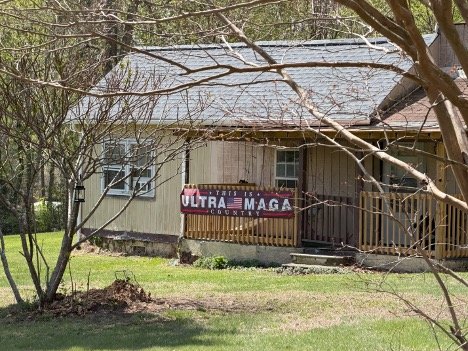
Rural Virginia home in early 2026.